

In the first few years of life, a child’s brain is a powerhouse of activity, forming upwards of 1 million new neural connections every second. Neuroscience confirms that rich sensory environments aren't just "extra credit"—they are the primary architecture upon which high-level cognitive skills are built.
Today, we’re looking at three professional-grade tools from Masterkidz that turn empty wall space into "learning windows" through touch and sight.
1. Tactile Training Board A: The Language of Texture
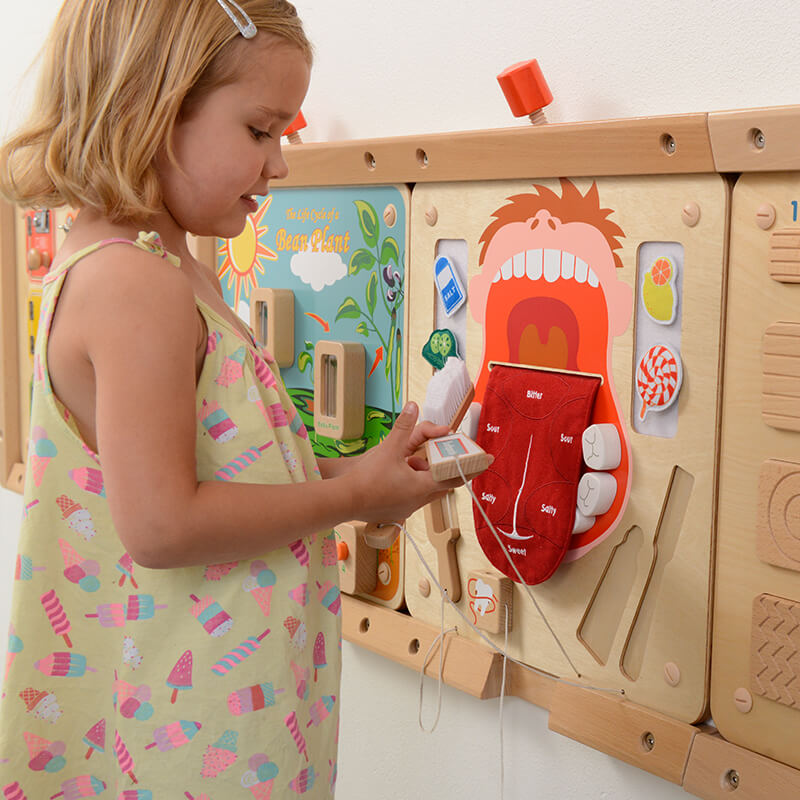
While many toys offer a single sensation, Board A features nine distinct solid wood blocks, each meticulously treated to offer a unique tactile signature.
-
Why it works: By navigating textures from "coarse" to "glass-smooth," children build a library of sensory vocabulary.
-
The Educational Edge: This isn't just about touch; it’s a language incubator. Educators use these panels to prompt descriptive adjectives, bridging the gap between physical sensation and verbal expression.
 2. Tactile Training Board B: The Logic of Matching
Moving beyond simple exploration, Board B introduces Tactile Discrimination. Featuring nine pairs of varied materials, it challenges children to find "the perfect match" using only their hands.
-
The "Blindfold Challenge": Teachers often encourage students to close their eyes while matching. This isolates the tactile sense, boosting working memory and logical reasoning.
-
Social Learning: Designed for 460x460mm wall mounting, it creates a natural "social station" where children collaborate and communicate their findings.

3. Visual Rotation Game: Tracking and Focus
Visual tracking—the ability of the eyes to follow a moving object—is a foundational skill for reading. The Masterkidz Visual Rotation Game uses the principle of persistence of vision through five vibrant, spinning wheels.
-
Inclusive Design: This panel is a proven favorite for neurodivergent learners. The predictable, rhythmic motion is particularly effective at helping children with Autism Spectrum Disorder (ASD) regulate their focus and calm their nervous systems.

Data Insights: Why Sensory Walls Matter in 2026
Research into the "Sensory Play" market and educational outcomes highlights a growing trend in North American classrooms:
| Metric | Impact Detail |
| Neural Growth | Sensory-rich environments increase synaptic density in the cerebral cortex. |
| Engagement Rate | Wall-mounted panels see 35% higher usage in classrooms compared to bin-stored toys because of constant accessibility. |
| Safety Standard | 100% compliant with ASTM F963 (USA) and GB 6675, ensuring zero-VOC water-based finishes and "no-pinch" engineering. |
Built for the Modern Classroom
Crafted from premium European Beech and multi-layer birch plywood, these panels are built for the high-traffic demands of daycares and schools. They are sanded, rounded, and finished with child-safe water-based lacquer—because we know that "learning is fun" only when it is safe.
By integrating these Masterkidz panels, you aren't just decorating a wall; you are planting the seeds for a lifetime of curiosity.